
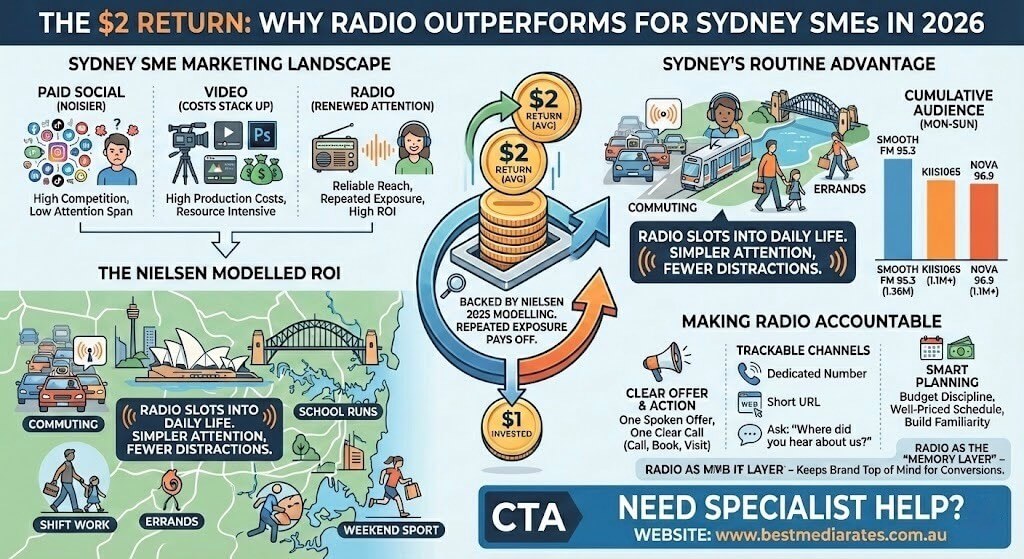
Small business marketing in Sydney has become a tighter balancing act. Paid social is noisier, video costs stack up quickly, and plenty of owners still feel unsure which channel actually drove the phone to ring. That’s why radio advertising ROI is getting renewed attention in Sydney, backed by Nielsen’s 2025 ROI modelling cited by Commercial Radio & Audio (CRA): AM/FM radio returning about $2 for every $1 invested.
What “$2 return” means?
A $2 return does not mean every business doubles its money every time. It’s an average from modelling across campaigns, categories, and conditions.
The more useful takeaway is this: when you buy a channel that reliably reaches the right people, repeated exposure can still pay off, even if it feels less “trackable” than clicks.
CRA’s point is that many marketers underrate radio while the measured results sit much higher.
Local radio advertising in Sydney still fits how the city moves
Sydney is built around routines: commuting, school runs, shift work, errands, weekend sport. Radio slots into those moments because it’s easy to keep on while doing other things.
The audience numbers support that radio remains a mass medium in Sydney. Smooth FM 95.3 posted a cumulative audience of about 1.36 million (Mon–Sun), while KIIS1065 and Nova 96.9 were also above 1.1 million.
For SMEs, that matters because local buying decisions are often made across days, not minutes. Repetition does the heavy lifting. A person hears an offer on the way to work, hears it again during errands, and remembers it when they’re ready to act.
Radio’s advantage: simpler attention, fewer distractions
Radio is not magic. People still zone out. They still miss messages. Yet the listening environment can be calmer than a scroll feed packed with competing content.
That helps explain why audio advertising ROI can look strong in studies even when radio feels less fashionable in marketing circles. When the message is short, repeated, and locally relevant, it can cut through without needing constant creative refreshes.
A practical point for Sydney SMEs: radio often works best as the “memory layer” of a plan. It keeps the brand top of mind so that search, maps, walk-ins, and referrals convert more easily.
Making radio accountable for SMEs
Radio becomes far more persuasive when you can connect it to outcomes. SMEs don’t need perfect attribution. They need enough signal to make decisions.
Ways to make it measurable:
- Use one spoken offer and one clear action (call, book, visit, quote request).
- Add a dedicated phone number or short URL for the campaign.
- Train staff to ask, “Where did you hear about us?” and actually record the answer for a few weeks.
Budget discipline also matters. Radio advertising rates vary by station, season and daypart. A well-priced schedule that repeats your message can outperform a scattered plan that never builds familiarity.
If you want specialist help with planning and negotiation, a media buying agency in Sydney like Best Media Rates can be useful for matching station choices and time slots to the audience you actually need, rather than buying on guesswork.
Also Read: Benefits of Radio Advertising: All You Need to Know
Frequently Asked Questions:
1. Is radio advertising worth it for a small business in Sydney in 2026?
It can be, particularly if you sell locally and depend on calls, bookings or foot traffic. Radio’s strength is steady reach and repetition, not one-off spikes. It tends to suit service businesses, retail, hospitality, health, and home services where people choose from a shortlist. Nielsen’s ROI modelling cited by CRA is one reason radio is back in the conversation, but your result will still depend on message, frequency and offer.
2. How much does it cost to advertise on Sydney radio?
There isn’t one fixed price. Costs move based on station demand, the time slot (breakfast and drive are usually premium), and how long you commit. Many SMEs start with a controlled test flight, then expand if enquiry volume rises. A good plan buys enough spots to be remembered, rather than spreading a small budget too thin across too many placements.
3. How do I track sales or leads from radio ads without fancy tech?
Keep it simple: a unique phone number, a short landing page link, and a spoken code customers can repeat. Compare calls, form fills, bookings or in-store mentions during the campaign against a normal baseline. Staff notes matter more than people expect. When your receptionist asks every caller “How did you find us?”, patterns show up fast.
4. Is radio better than Facebook, Instagram or TikTok ads for local lead generation?
Neither is automatically “better”. Social can be excellent for retargeting and quick testing. Radio often shines when social costs rise, reach becomes inconsistent, or you need broader local coverage than your followers. Many Sydney SMEs do well by pairing radio for reach with social for follow-up, so interested people keep seeing the brand after they’ve heard it.
5. How long should a radio campaign run before judging results?
A short burst can help with a sale or event, but most SMEs need enough time for repetition to work. A few weeks is often a more realistic window than a few days. Avoid rewriting the message every week, because you reset memory each time. Set one clear metric (calls, bookings, store visits), run consistently, then review results against your baseline.